
Legacy MTL4842 HART Interface Module for Maintaining Installed MTL4840 Systems
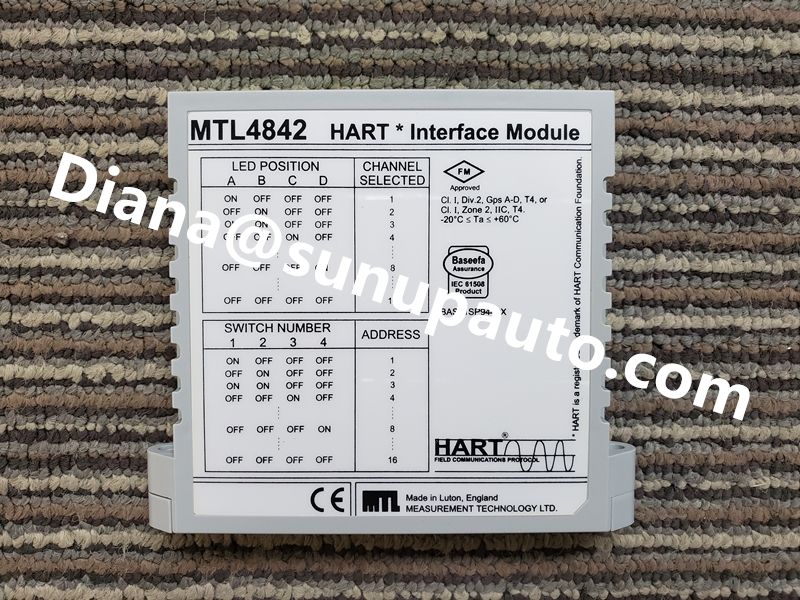
Eaton MTL4842 is a discontinued HART interface module from the MTL4840 HART maintenance system. It remains relevant to plants that still operate the original architecture and need an exact spare for repair, shutdown preparation, or long-term support. In the MTL4840 arrangement, one MTL4842 interfaces with as many as sixteen instrument loops through the associated backplane.
How the Module Operates in the MTL4840 Architecture
The MTL4842 receives multiplexer control from an MTL4841 communications module and selects one connected loop at a time for HART communication. Up to sixteen MTL4842 modules may be managed by one MTL4841, giving the original system access to as many as 256 HART devices. A switch-selectable unit address distinguishes each MTL4842 within the group.
Front indicators make service work easier: a green LED shows power, an amber LED identifies the selected module, and four red indicators display the loop address. Power is supplied through the backplane, with published consumption below 0.1 W. The interface bus between module positions 1 and 16 is limited to four metres, an important detail when reviewing an existing cabinet layout.
A Maintenance Record Worth Building
Because MTL4842 is no longer a current-production item, a useful purchase record should contain more than a model number. Photograph the front and side labels, record the backplane type, note the MTL4841 configuration, and capture the unit-address setting before removing the old module. If a fault appears intermittent, technicians should also inspect the backplane contacts, power supply, interface bus, and field loop before assuming the MTL4842 itself is the only cause.
Published environmental references for the MTL4840 family include operation from -20 to +60 degrees C, storage from -40 to +80 degrees C, and 5 to 95 percent relative humidity without condensation. The equipment may be installed in a safe area or an appropriately approved Division 2 location, subject to the exact version and current certification documents.
Buying a Discontinued MTL4842
Request the exact MTL4842 model, quantity, acceptable condition, required test or traceability documents, destination, and delivery deadline. For urgent replacement, include clear label photographs and advise whether a single spare or a matched group is required. Sunup-MTL can help coordinate availability for legacy MTL4842 demand, but compatibility must be verified against the installed MTL4840 system, current manufacturer information, and the plant's approved maintenance procedure before installation.
Why Legacy HART Infrastructure Still Matters
Many process plants continue to obtain useful diagnostic and configuration data from HART instruments installed decades ago. The MTL4840 system provided a practical way to connect plant-wide maintenance software to those field devices without interrupting the primary 4-20 mA control signal. Within that architecture, MTL4842 performs the loop-selection role. Replacing a failed MTL4842 can therefore restore access to multiple transmitters, even when the control loops themselves continue to operate normally.
This distinction is important during fault investigation. Loss of HART maintenance communication does not automatically mean the analogue measurement has failed, and a healthy analogue value does not prove that the MTL4842 path is working. Operations, instrumentation, and system-support personnel should agree on the symptoms before parts are changed.
Build a Cabinet Map Before Removing Hardware
A reliable maintenance record should show the position of every MTL4842, its switch-selected unit address, the loops connected through its backplane, and the associated MTL4841 communications module. Include the cabinet name, rack position, power source, interface-bus route, computer or server connection, and software node name. This map is especially valuable in a large installation where several cabinets contain similar modules.
Before removal, photograph the LED state and address switch. Mark the module position and verify that the replacement will not create a duplicate address. If more than one module is being changed, replace and test them individually so that any new fault can be traced to a specific action.
A Structured Troubleshooting Workflow
Confirm the scope: determine whether one loop, one MTL4842, one cabinet, or the complete HART network is affected.
Check power and indicators: verify the green power LED, amber selection indication, and red loop-address display during a communication request.
Review addressing: confirm the MTL4842 unit address and the software configuration used by the MTL4841.
Inspect the backplane: look for loose connectors, contamination, damaged contacts, or signs of overheating.
Check the interface bus: confirm continuity, connector orientation, cable condition, and compliance with the published four-metre limit across the module group.
Test known points: use an approved HART communicator or maintenance application to compare a working loop with the failed path.
Do not repeatedly plug and remove modules with the system energized unless the applicable instructions and site procedure explicitly permit it. The original system may be installed in a safe area or approved Division 2 environment, so location requirements, permits, and electrostatic-discharge precautions must be observed.
Acceptance Checks for a Replacement MTL4842
After fitting the replacement, confirm that the module powers correctly and responds when selected. Test several representative loops, including channels at different addresses. Verify that the maintenance software can read device identification, process variables, status, and configuration information without disturbing the analogue signal. Record the replacement serial number, source, date, cabinet position, address setting, and test results.
If the unit is supplied from legacy inventory, inspect the packaging and module carefully. Long storage can expose equipment to humidity, dust, corrosion, or mechanical damage. Confirm the requested condition and any testing expectations before shipment. A visual inspection alone cannot guarantee operation, so the receiving plan should include functional verification in an appropriate system or approved test arrangement.
Obsolescence and Spare-Stock Planning
Because MTL4842 is discontinued, plants should know how many modules remain installed, how many are held as tested spares, and which cabinets depend on them. Store spares in controlled conditions, protect connectors, and retain manuals and configuration records with the inventory. Periodically check that maintenance computers, communication interfaces, and software backups remain available; a spare module alone may not restore service if the supporting system knowledge has been lost.
For purchasing, state the exact MTL4842 model, quantity, required condition, destination, urgency, and documentation needs. Mention whether testing, photographs, serial records, or export documents are required. Sunup-MTL can assist with locating MTL4842 and related legacy MTL4840 components, but engineering approval should be based on the installed system, current site procedures, and a clear lifecycle strategy.