
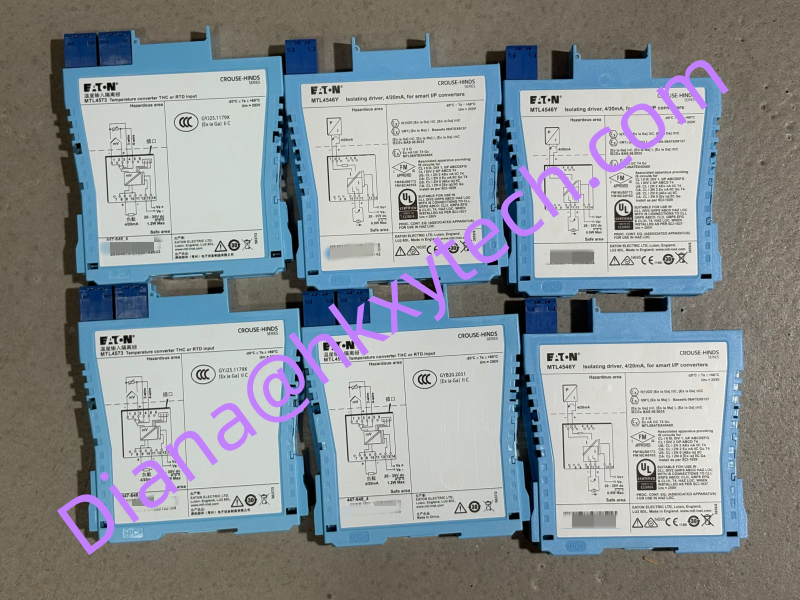
Eaton MTL4573 Configurable Temperature Interface for Hazardous-Area Thermocouples and RTDs
Eaton MTL4573 converts a low-level temperature or resistance signal from a hazardous-area sensor into an isolated 4-20 mA signal for a safe-area control system. The single-channel module supports common thermocouples, millivolt inputs, and two-, three-, or four-wire RTDs. Software configuration allows the same MTL4573 hardware to be ranged, linearized, monitored, tested, and tagged for many different temperature duties.
Choose the Sensor Type Before Choosing the Range
A temperature loop begins with the sensor. Thermocouples generate a small millivolt signal related to the temperature difference between the measuring junction and the reference junction. RTDs change resistance with temperature and require an excitation current and lead-wire compensation. MTL4573 handles both principles, but the wiring, fault behavior, accuracy, and configuration are different.
Supported thermocouple references include J, K, T, E, R, S, B, N, and XK types. Published RTD options include Pt100, Pt500, Pt1000, selected nickel and copper sensors, and general resistance inputs. Confirm the actual sensor standard and range from the instrument datasheet rather than selecting only by the tag description.
Choosing the Input Configuration
MTL4573 supports several temperature and low-level signal families, but each application needs a configuration that matches the actual sensor, wiring method, measuring range, and required fault response.
Thermocouples: common choices include J, K, T, E, R, S, B, N, and XK. Confirm polarity, extension-cable type, cold-junction compensation, working range, and the location of every transition to copper wiring.
Millivolt inputs: the published reference range extends from -75 to +75 mV. Pay particular attention to electrical noise, grounding, source impedance, cable screening, and the minimum configured span.
Platinum RTDs: Pt100, Pt500, and Pt1000 selections require the correct two-, three-, or four-wire arrangement. Lead resistance and terminal consistency become especially important when the measuring span is narrow.
Other RTD and resistance inputs: selected nickel and copper characteristics and general resistance inputs up to the published 400-ohm reference may be available. The configured sensor curve must match the physical element and the applicable regional standard; a similar resistance at room temperature does not prove the correct characteristic has been selected.
Thermocouple Cold-Junction Compensation
Thermocouple measurement requires compensation for the temperature at the copper connection point. For MTL4573 thermocouple applications, the HAZ-CJC plug on terminals 1 to 3 includes an integral cold-junction sensor. Cold-junction compensation can be enabled or disabled in configuration, and Eaton publishes a compensation error reference of no more than 1 degree C.
Use the correct thermocouple cable all the way to the compensation point, maintain polarity, and avoid unwanted junctions of dissimilar metals. A reversed thermocouple may still produce a changing signal but in the wrong direction. Commissioning should include a known-temperature check or calibrated simulator, not only a continuity test.
RTD Wiring and Lead Resistance
A two-wire RTD includes both lead resistances in the measurement and is most suitable where cable resistance is small or accuracy requirements are modest. A three-wire RTD allows the converter to compensate for approximately equal lead resistance. A four-wire RTD provides the strongest compensation for precision measurement. MTL4573 terminal selection must match the configured wiring method.
When an RTD reading is unexpectedly high, compare the configured sensor type with the installed element, inspect terminal tightness, and measure lead resistance. Mixed cable sizes, corroded junctions, and unequal three-wire leads can create error without causing a complete sensor fault.
Configuration With PCS45
MTL4573 is configured from a computer using MTL PCS45 software and a PCL45USB interface. The configuration record should include sensor type, wiring method, lower and upper range values, output characteristic, damping, mains-frequency rejection, tag, sensor-failure direction, and early-burnout selection. Save an electronic copy and a readable commissioning report for every loop.
The 4-20 mA output can follow MTL or NAMUR NE 43 out-of-range behavior. On sensor failure, the output can be driven upscale, downscale, or turned off according to the approved control-system strategy. Early burnout detection can warn of increasing thermocouple loop resistance before the circuit becomes fully open; Eaton references an indication when the increase exceeds 50 ohms if the feature is selected.
Commissioning From Input to DCS
- Verify the MTL4573 label, backplane position, supply, and hazardous-area documentation.
- Confirm sensor type, polarity, cable type, and terminal assignment.
- Upload or review the configuration before applying a test signal.
- Simulate at least the lower range, midpoint, and upper range while comparing output current and DCS display.
- Test sensor open-circuit behavior and confirm the configured upscale or downscale response.
- Where used, verify early-burnout indication and alarm handling.
- Record as-left values, configuration filename, software version, serial information, and test equipment.
Applications and Procurement Notes
MTL4573 can serve reactor, furnace, pipeline, bearing, storage-tank, utility, and environmental temperature measurements. It is relevant to oil and gas, chemical, power generation, metals, food, pharmaceutical, marine, and general manufacturing facilities where the sensor is located in a classified area.
For a quotation, send the exact MTL4573 model, quantity, destination, delivery deadline, required condition, and a clear label photograph. If the request is a replacement, include the sensor type and saved configuration if available. On receipt, inspect the backplane connector and housing, verify the model, and store the module in suitable environmental and electrostatic conditions. Qualified personnel must confirm the sensor configuration, intrinsic-safety parameters, output scaling, and alarm response before installation.
Building a Temperature Measurement Error Budget
A successful loop test should consider the complete measurement uncertainty rather than the converter alone. For a thermocouple, the error budget may include sensor tolerance, extension-cable accuracy, cold-junction compensation, input calibration, output accuracy, DCS input accuracy, temperature drift, and the reference instrument used for testing. For an RTD, add element class, lead resistance, self-heating, wiring method, transmitter excitation, and installation effects such as thermowell response or stem conduction.
Eaton publishes input and output accuracy references for MTL4573, but those values must be combined with other loop components in a method appropriate to the project. A narrow configured span can make a small input error more significant as a percentage of output span. Engineers should confirm that the selected sensor, range, and installation can meet the required process accuracy before commissioning.
Response time also matters. The MTL4573 has a typical response reference of approximately 500 ms, while the sensor assembly and thermowell may respond much more slowly. For control loops, alarm functions, and trip applications, evaluate the complete thermal response. A fast electronic converter cannot compensate for a poorly located sensor or an oversized thermowell. Record the expected normal rate of change so technicians can distinguish process behavior from signal noise or sensor deterioration.