
Maintaining and Replacing the Legacy Eaton MTL5032 Pulse Isolator in Industrial Measurement Loops
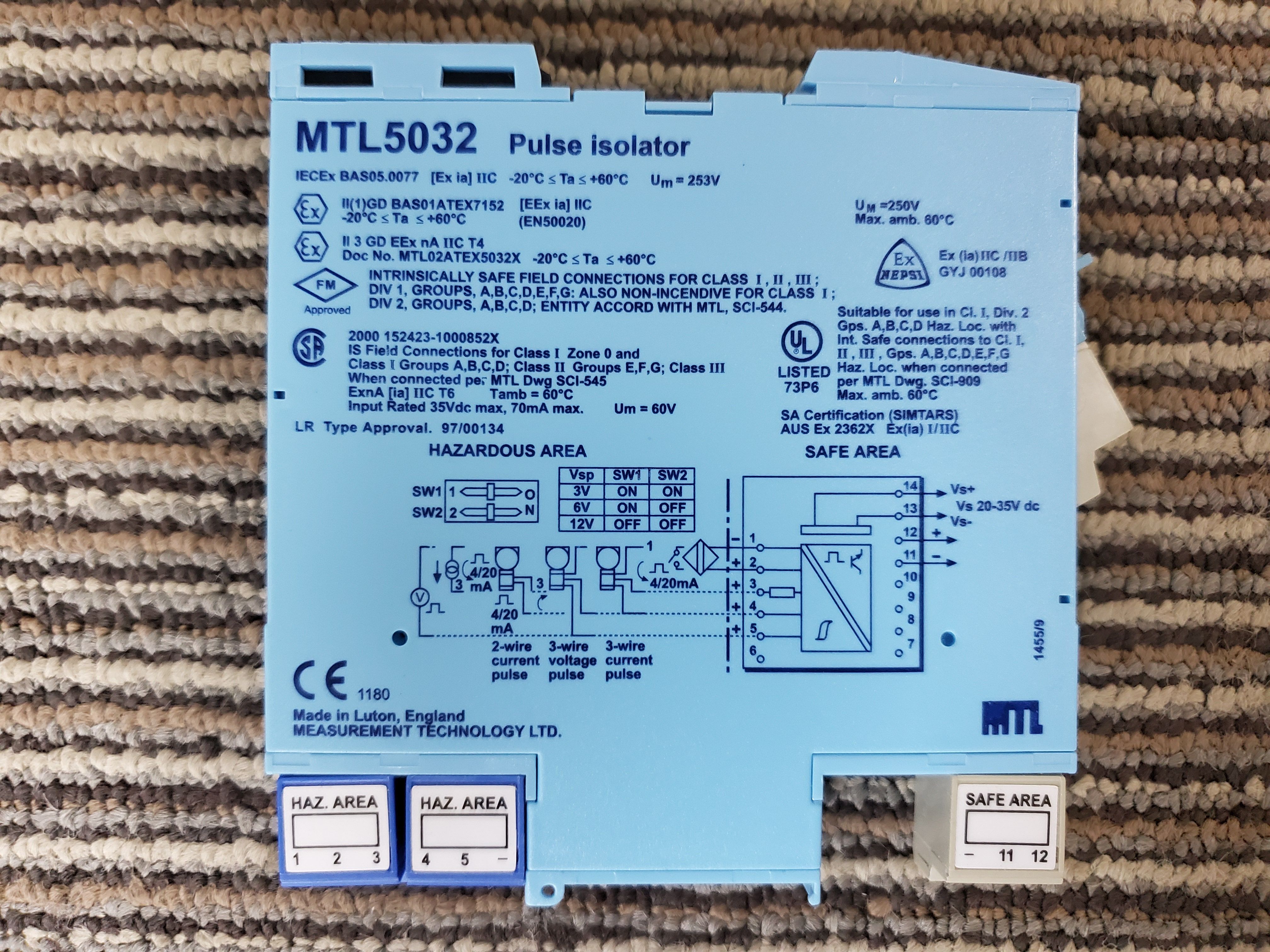
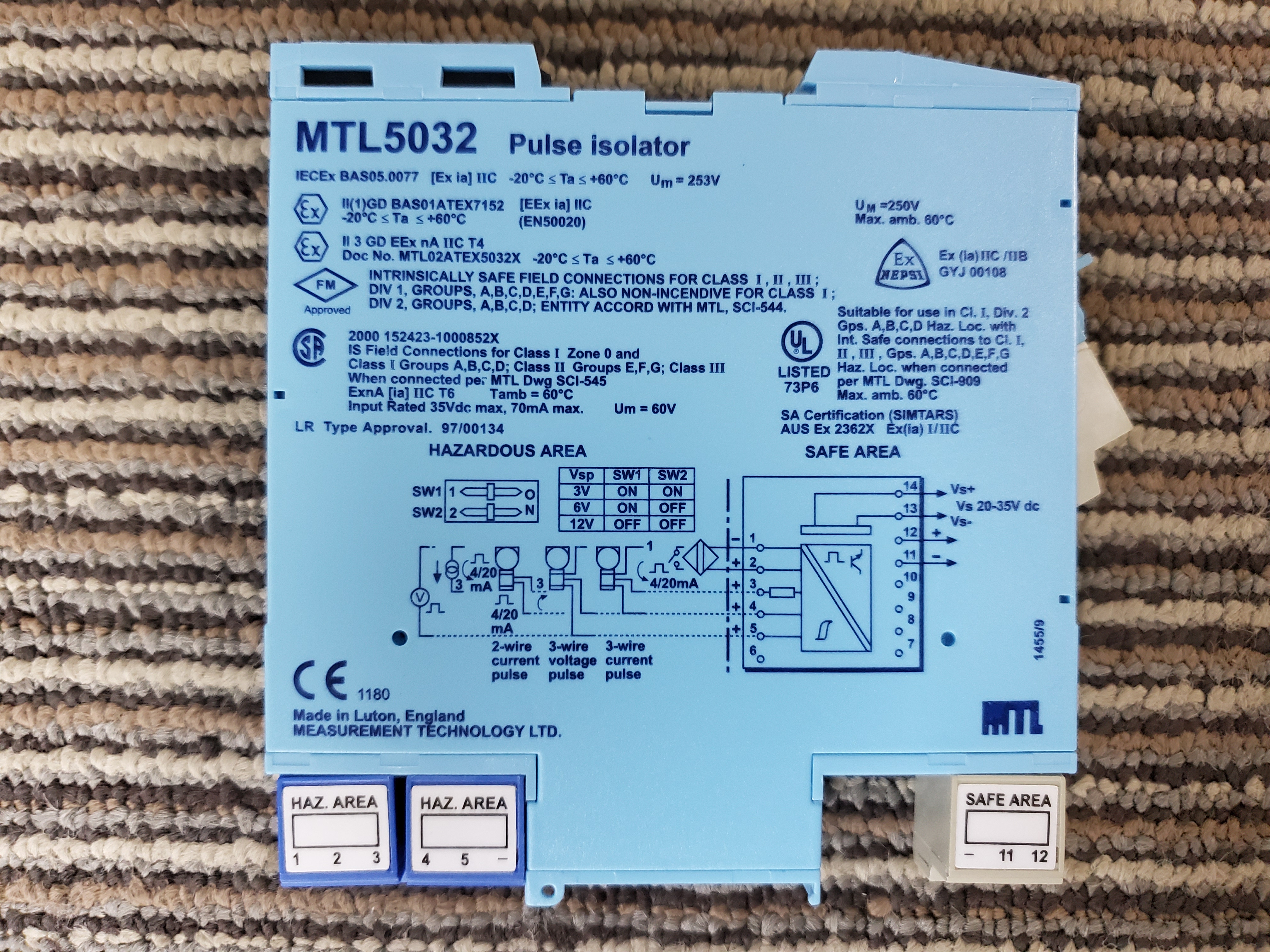
Eaton MTL5032 is a legacy pulse isolator from the MTL5000 family. It was used to transfer pulse or frequency information from hazardous-area instrumentation to safe-area monitoring and control equipment while maintaining galvanic and intrinsic-safety separation. Typical installed duties may include speed, flow, totalization, proximity-sensor, turbine-meter, or event-counting applications. Because MTL5032 is now supported as a discontinued product, purchasing and replacement work should begin with the installed circuit rather than assuming that a newer model is a direct drop-in substitute.
A Pulse Loop Carries More Than an On or Off State
A digital status loop changes occasionally, but a pulse isolator may transfer thousands of transitions while preserving frequency and timing. Missing, duplicated, or distorted pulses can create an incorrect speed, flow total, production count, or equipment-state calculation. MTL5032 selection therefore depends on sensor type, amplitude, frequency range, switching threshold, output arrangement, cable characteristics, and the receiving input.
Before replacing MTL5032, record the normal operating frequency and the minimum and maximum values expected during startup, steady operation, and shutdown. Identify whether the field source is a NAMUR proximity detector, switch contact, voltage pulse, magnetic pickup, or another certified device. Verify what the safe-area system expects: a pulse output, alarm state, frequency signal, or calculated analog representation.
Build an Installed-Circuit Record Before Removal
Legacy systems are often maintained from partial drawings. Photograph the MTL5032 front and side labels, record every terminal number and conductor color, and trace the safe-area output to its receiving card. Note any links, switches, resistor networks, external power supplies, shield connections, and shared commons. Capture the control-system scaling and alarm values before isolating the loop.
If the application measures flow or speed, also record engineering units, pulse factor, gear or turbine data, and the relationship between frequency and process value. A replacement can pass pulses correctly and still produce a wrong displayed result if the receiving system was reconfigured during the work.
Troubleshooting Without Guessing
No output: verify the MTL5032 supply, field-sensor voltage or current, terminal polarity, open circuits, and safe-area wiring. Simulate a known input only with an approved method that respects the hazardous-area design.
Unstable frequency: inspect sensor gap, mechanical vibration, cable screening, grounding, electrical noise, loose terminals, and the quality of the source waveform. Compare the pulse train at the field side and receiving side with suitable isolated test equipment.
Correct frequency but wrong process value: check the pulse factor, control-system scaling, time base, totalizer settings, and engineering units. This symptom frequently lies outside the isolator itself.
Failure only at high speed: confirm the maximum input frequency, pulse width, receiving-card capability, and cable waveform. A workshop test at low frequency may not expose a bandwidth or pulse-shape problem.
Migration Requires an Engineering Comparison
Eaton lists MTL5032 in its discontinued-product support information and references MTL5532 as a later pulse-isolator option with additional 4-20 mA output and alarm capability. That cross-reference is a starting point, not automatic authorization to exchange modules. The MTL5000 and MTL5500 families differ in terminals, power connection, dimensions, approvals, functions, and configuration.
Prepare a comparison covering input type, frequency range, trigger levels, hazardous-area parameters, output types, line fault behavior, power supply, response time, environmental limits, mounting, terminal assignments, and certification. Review the receiving control logic and any shutdown function. If the existing MTL5032 participates in a safety-related or custody-measurement application, migration should follow the applicable management-of-change and validation process.
Decide Whether the Need Is Repair, Spare Stock, or Modernization
An urgent production problem and a planned obsolescence project require different decisions. For an urgent repair, the priority may be obtaining a verified MTL5032 that preserves the existing wiring and control logic. For strategic spare stock, the plant should estimate the installed population, failure history, storage conditions, and expected operating life. For modernization, the objective is to remove dependency on obsolete hardware through an engineered replacement package.
Create an inventory that separates active MTL5032 channels from disconnected modules still mounted in old panels. Record process duty, sensor model, normal frequency, output destination, shutdown consequence, and available downtime. The result often shows that only a small number of loops are critical, allowing engineering work and spare investment to be directed where a failure would have the greatest operational impact.
Condition also matters when legacy stock is purchased. Ask whether the unit is new surplus, unused old stock, refurbished, or previously installed. Inspect terminal condition, housing damage, labels, date information, and storage history. A clean exterior is not proof of electrical performance, so the receiving plan should include a functional pulse test before the module is accepted into maintenance stores.
Commissioning a Replacement Pulse Path
- Confirm the exact installed model and approved replacement decision.
- Check hazardous-area certification, cable parameters, sensor compatibility, and terminal assignments.
- Apply several known frequencies across the operating range and compare safe-area output behavior.
- Verify control-system indication, scaling, alarm limits, totalization, and pulse count.
- Test startup and low-speed behavior, where narrow pulses or sensor chatter may appear.
- Run the process at a representative high frequency and compare against an independent reference.
- Restore shields, covers, labels, and bypasses, then record the as-left configuration.
Keep Evidence That the Measurement Chain Is Correct
A useful acceptance record includes the signal-generator reference, test frequencies, measured output, control-system display, alarm response, and totalizer change. Attach before-and-after wiring photographs and identify the person who removed temporary forces. This evidence helps future technicians distinguish an isolator problem from a field sensor, cable, or software-scaling issue.
After the process returns to service, compare the reported value with an independent operating reference and review trends for missed counts or sudden steps. The final field check is especially important for equipment that cannot reach full speed during a workshop or shutdown test.
Ordering MTL5032 for Maintenance Stock
For an MTL5032 inquiry, provide the exact model, quantity, destination, delivery deadline, condition requirement, and photographs of the product label and wiring. Explain whether the request is for direct legacy replacement, planned migration, or emergency troubleshooting. Include the field-sensor model and receiving input when compatibility needs confirmation.
Sunup-MTL can assist with availability checking, quotation, packing, export documents, and international delivery for MTL5032 and related MTL products. Final suitability, certification, wiring, configuration, and commissioning must be confirmed by qualified personnel using the current manufacturer support information and the approved plant drawings.