
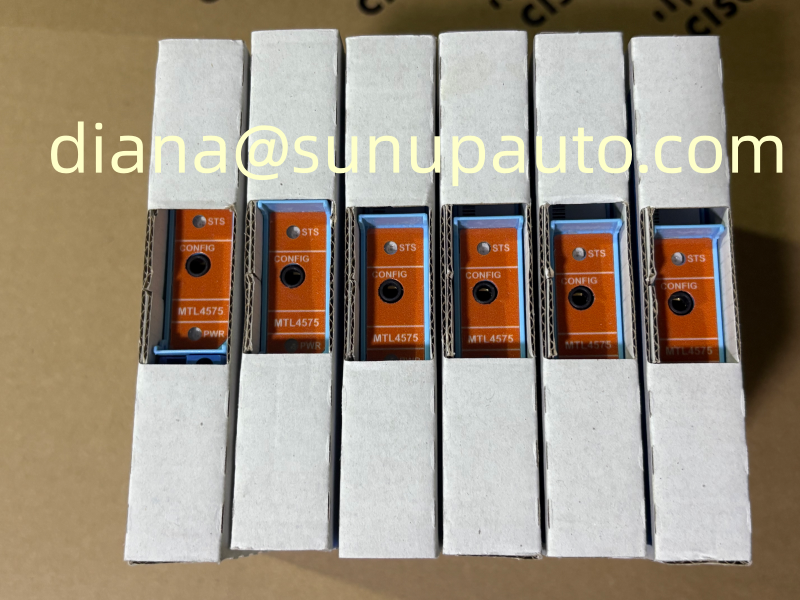
Eaton MTL SLP32D Dual-Channel Surge Protection for Data, Signal, and Instrument Loops
The Eaton MTL SLP32D is a compact hybrid surge protection device designed for two signal loops or one four-wire circuit. It is frequently specified where sensitive measurement, control, or communication wiring may be exposed to lightning-induced transients and other electrical surges. With a slim 12 mm DIN-rail format, MTL SLP32D helps maintenance teams add robust protection without consuming unnecessary cabinet space.
Technical Snapshot
| Nominal operating voltage | 24 V |
| Maximum continuous voltage | 32 V |
| Load current | Up to 1.5 A |
| Nominal discharge current | 10 kA, 8/20 microsecond waveform |
| Signal bandwidth | 50 MHz |
| Response time | Less than 1 ns |
Where MTL SLP32D Adds Practical Value
In process plants, long field cables can provide a path for damaging transient energy. Installing MTL SLP32D near the protected equipment helps divert surge current while maintaining the normal signal path. Typical uses include transmitter circuits, alarm and shutdown wiring, telemetry links, data channels, and general instrumentation circuits in oil and gas, chemical, water treatment, power, marine, and manufacturing facilities.
Two independent loops can be protected by one compact module.
Plug-and-header terminals simplify inspection and replacement.
DIN-rail mounting supports organized panel construction.
A wide operating temperature range suits demanding industrial sites.
Engineering and Ordering Checks
Before ordering MTL SLP32D, confirm the normal loop voltage, maximum current, required protection level, earthing arrangement, hazardous-area documentation, and available mounting space. Surge protection performance depends on correct installation, short bonding conductors, and suitable coordination with equipment at the opposite end of the cable. For an exact quotation, provide the complete model MTL SLP32D, quantity, destination, required delivery date, and a clear photograph of the existing label when the item is for replacement.
Sunup-MTL can support MTL SLP32D sourcing for planned projects, shutdown preparation, cabinet repairs, and spare inventory. Final selection and installation should be checked by qualified personnel against the current Eaton documentation and the approved site design.
Understanding Surge Exposure in Instrument Circuits
A surge does not need to strike the control cabinet directly to damage an instrument loop. Nearby lightning activity, switching of inductive loads, faults on adjacent power cables, and differences in earth potential can all create fast transient voltages. Long outdoor cable routes are especially exposed because they can collect energy and carry it toward transmitters, PLC inputs, communication equipment, and barrier panels. MTL SLP32D provides a controlled path for this transient energy while allowing the intended low-voltage signal to continue through the circuit. The device should be considered as one part of a coordinated protection design rather than as an isolated accessory.
For sites with repeated unexplained input-card failures, intermittent transmitter faults, or damage after thunderstorms, a review of the complete surge protection concept can be valuable. The review should include field-device protection, cabinet-entry protection, cable shielding, bonding, earthing, and separation from power conductors. MTL SLP32D may be suitable at selected boundaries, but the final location must be chosen according to the source of exposure and the equipment that requires protection.
Installation Quality Has a Direct Effect on Protection
Even a correctly selected surge protector can perform poorly if the installation adds excessive conductor length or impedance. Keep the connection from MTL SLP32D to the earth or bonding point as short and direct as the approved design allows. Avoid unnecessary loops, sharp routing changes, and shared conductors that may carry unrelated fault current. The incoming exposed cable and the protected outgoing cable should be routed separately so that transient energy cannot couple around the protection device.
The DIN rail, enclosure earth, cable screen arrangement, and local equipotential bonding network should be checked before installation. In hazardous-area applications, intrinsic-safety segregation, terminal identification, applicable certificates, and entity or system documentation must also be respected. MTL SLP32D does not replace the engineering requirements for the complete intrinsically safe circuit.
Loop Review Before Selecting MTL SLP32D
- Confirm the normal operating voltage and the highest continuous voltage expected on the line.
- Check that the circuit current remains within the published load-current limit.
- Review signal frequency, communication requirements, and allowable insertion effects.
- Identify whether two separate loops or one four-wire circuit will be protected.
- Confirm the required surge rating and coordination with upstream or downstream protection.
- Verify the operating temperature, enclosure conditions, terminal type, and available rail space.
For analogue loops, verify that the transmitter, receiving input, loop supply, cable resistance, and protection device work together within the available voltage margin. For digital or high-frequency signals, the 50 MHz bandwidth is useful, but the actual waveform and protocol should still be reviewed. Never assume that every 24 V circuit has the same electrical behavior.
Inspection, Testing, and Maintenance Practice
Record the installation location and protected loop number when MTL SLP32D is fitted. During planned maintenance, inspect the module, terminals, earth connection, and surrounding wiring for looseness, corrosion, heat damage, contamination, or mechanical stress. A visual inspection after a known surge event is also sensible. If the protected circuit behaves abnormally, test the loop using an approved procedure and compare results with the original commissioning record.
Replacement should be treated as controlled maintenance. Isolate the circuit where required, label conductors before removal, verify polarity and channel assignment, and restore the original bonding arrangement. After installation, complete the appropriate continuity, insulation, functional, and communication checks without applying test voltages that could damage connected electronics.
Applications and Purchasing Support
MTL SLP32D can be considered for pressure, flow, level, and temperature transmitter loops; shutdown contacts; remote alarm circuits; packaged skids; tank-farm instrumentation; water-treatment assets; pipeline stations; and other systems where exposed cabling connects to valuable electronics. It may also be stocked as a standardized spare when a facility uses the same protection design across several cabinets.
When requesting MTL SLP32D, provide the exact label code, quantity, application voltage, destination, delivery deadline, and required documents. State whether the order is for new construction, direct replacement, or warehouse replenishment. On receipt, compare the part number and package quantity with the purchase order, inspect for transport damage, and keep the terminals protected until installation. These simple controls help ensure that the correct MTL SLP32D reaches the maintenance team in usable condition.